.png)
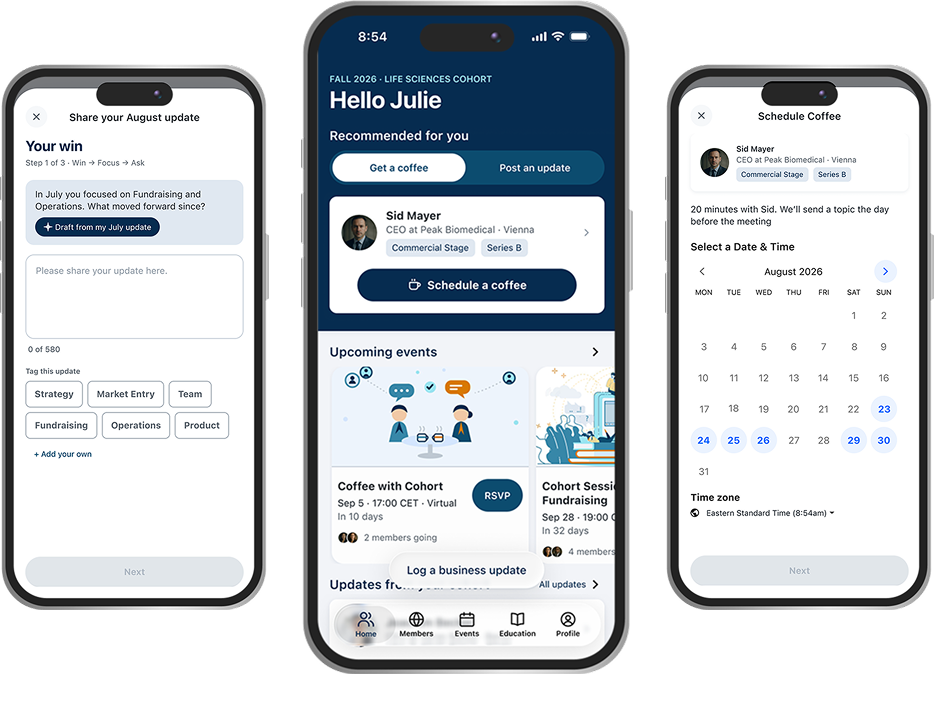
Designing for connection between sessions
Breaking into the US market with no roadmap, no local network, and no one who truly understands the pressure you're under is difficult. It's also lonely. CEO XB was built for exactly that moment. CEO XB is a cross-border program connecting European Life Science CEOs to a trusted group of peers on the same journey.
Over 20 weeks, a four-person team redesigned full lifecycle features from onboarding to retention, delivering a live vision prototype, not a long report.
Impact
Role
Company Name
Timeline
opportunity
How might we make business moves visible in a way that feels natural and leads to virtual coffee (or tea!)?
Peer communities often fail because members can’t easily see each other’s thoughts, feelings or day-to-day activities. This leaves little motivation to connect. CEO XB solves this for European CEOs entering the U.S. market.
Visible business updates create timely, natural openings for connection by letting members see where peers are in their journey.
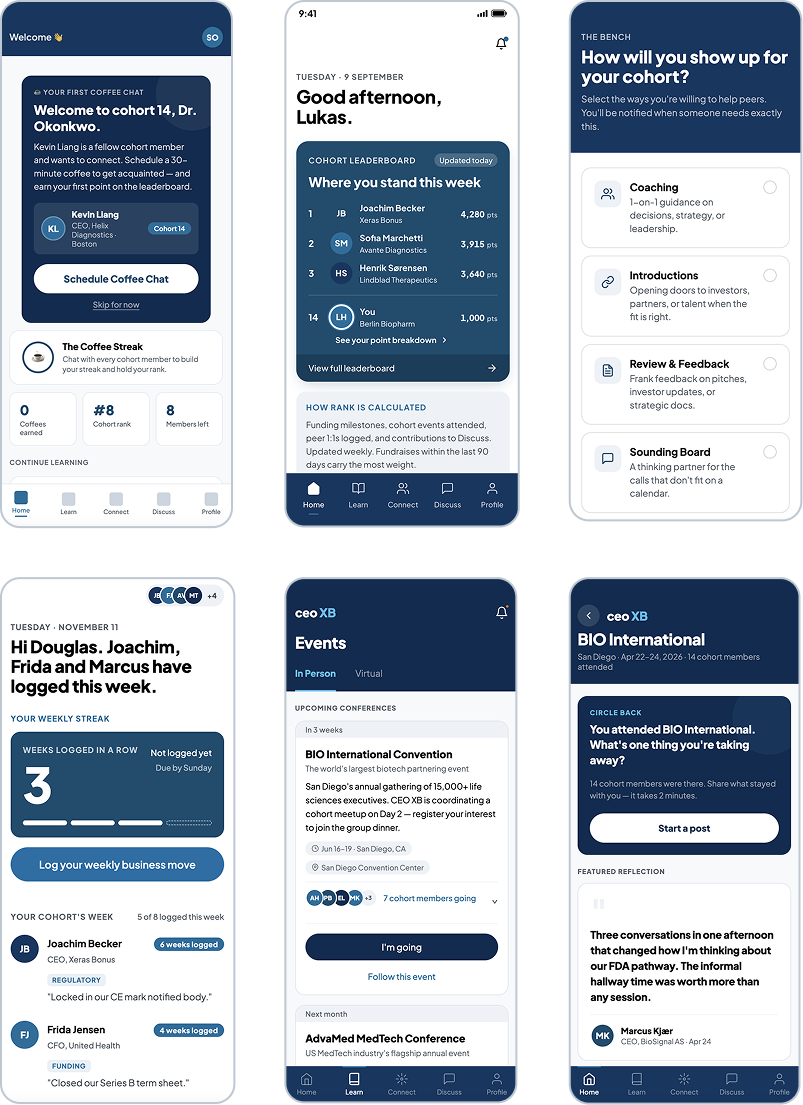
But visibility is only the first step; the real goal is connection. We designed a digital experience where every interaction can lead to a one-on-one or coffee chat.
Our AI-assisted update flow, powered by the live Anthropic API, lets CEOs easily share wins, focus areas, and support needs. Peers can then schedule a coffee with one tap, all within the platform.
I led as a player-coach across a four-person team, personally responsible for design consistency, quality, and system architecture.
Follow our hero CEO Julie Berg's journey in the vision prototype.
challlenges
We inherited a digital platform with no clear value proposition and a custom design language
CEO XB had a vision but the core engagement model and value proposition for a digital platform wasn't fully shaped. Previously, they wanted it to be an education platform. Now, they wanted it to be a platform that would help engage and retain t heir members.
Defining what will make a CEO keep coming back
To get to our design challenge, we needed to first:
Validate what drives engagement and connection: What keeps a CEO coming back to a peer community? We researched accountability, challenge-based progression, and cohort dynamics directly with users through a series of live prototypes, learning what resonates, what falls flat, and what CEO XB should double down on. Then, we designed and evaluated our solutions.
Define how to deliver that value through a digital platform: Not every aspect of peer accountability translates naturally to a screen. We identified which parts of the CEO XB experience a digital platform can own, which it should support, and which are better left to human facilitation.
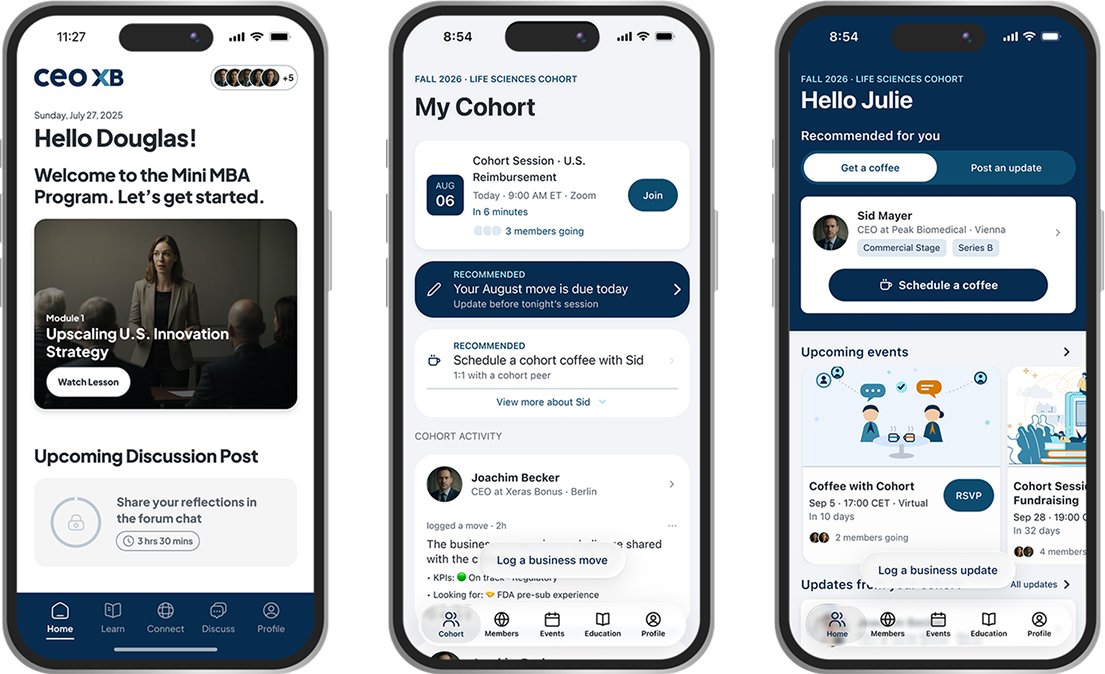
The main entry point had to deliver on the new value prop
AI-assisted rapid prototyping with Claude and Vercel
Time constraints meant we needed a different approach than building prototypes from scratch. The solution was Claude-assisted prototyping. We created a shared markdown document that had all the context Claude needed to know about the platform before touching a single concept: the design language, the color tokens, the component patterns, and the anti-patterns to avoid.
We updated the concept instructions in that file and left everything else in place when we wanted a new concept. Claude inherited the system knowledge it needed each time. The fidelity came from the preparation, not the prompting. Each concept was built as a React web app, live on Vercel, in hours, not days or weeks. Then, we used Optimal Workshop to conduct user research using the live prototypes.
Co-created prototypes used as research instruments for concept testing (live prototype example)
research and insights
Our new features are grounded in what we heard during research
The team conducted mixed-methods research from discovery to delivery, including stakeholder interviews, a literature review, generative concept test and evaluative task-based usability test.
Human facilitation is part of the product, not a gap in it
Our main stakeholder reminded us in an early design crit that CEO XB is a two-founder, human-gated system. The first iterations did not focus enough on CEO XB as the orchestrator of the program and the connections.
Emotional support carries the same weight as information
CEOs come to CEO XB for the market-entry knowledge. What keeps them coming back are the people that understand the pressure.
That's exciting. It's kinda good to know that people are in a similar boat as me.
Visibility creates the conditions for connection
People logging what they are up to. Progress they have made. I could maybe reach out if they have recently done something that I'm looking at doing in the near future or if I can help out in any way. That's pretty cool.
Members can't support each other until they can see what others are working on.
Connection is the outcome, not the feature
The platform's job is to produce 1:1 conversations. Every feature is measured against whether it creates a path to one.
Write with me, not for me
Because I generally like writing my own stuff. And I didn’t see a draft for me option that was like, different options to choose from or a multiple choice on what draft for me options would look like. If it had looked like Chatgpt or gemini or even given me like 3 “autocomplete” kind of options that matched what I thought we were doing, I would have moved forward with that, but as it was, it didn’t really make sense to me so I went with what I knew.
In our evaluative testing, we learned users wanted suggestions for how to improve their writing, such as a grammar check. They preferred to write the business update first, then get help with edits.
solution overview
How we made progress visible and connections easy
Coffee Chats
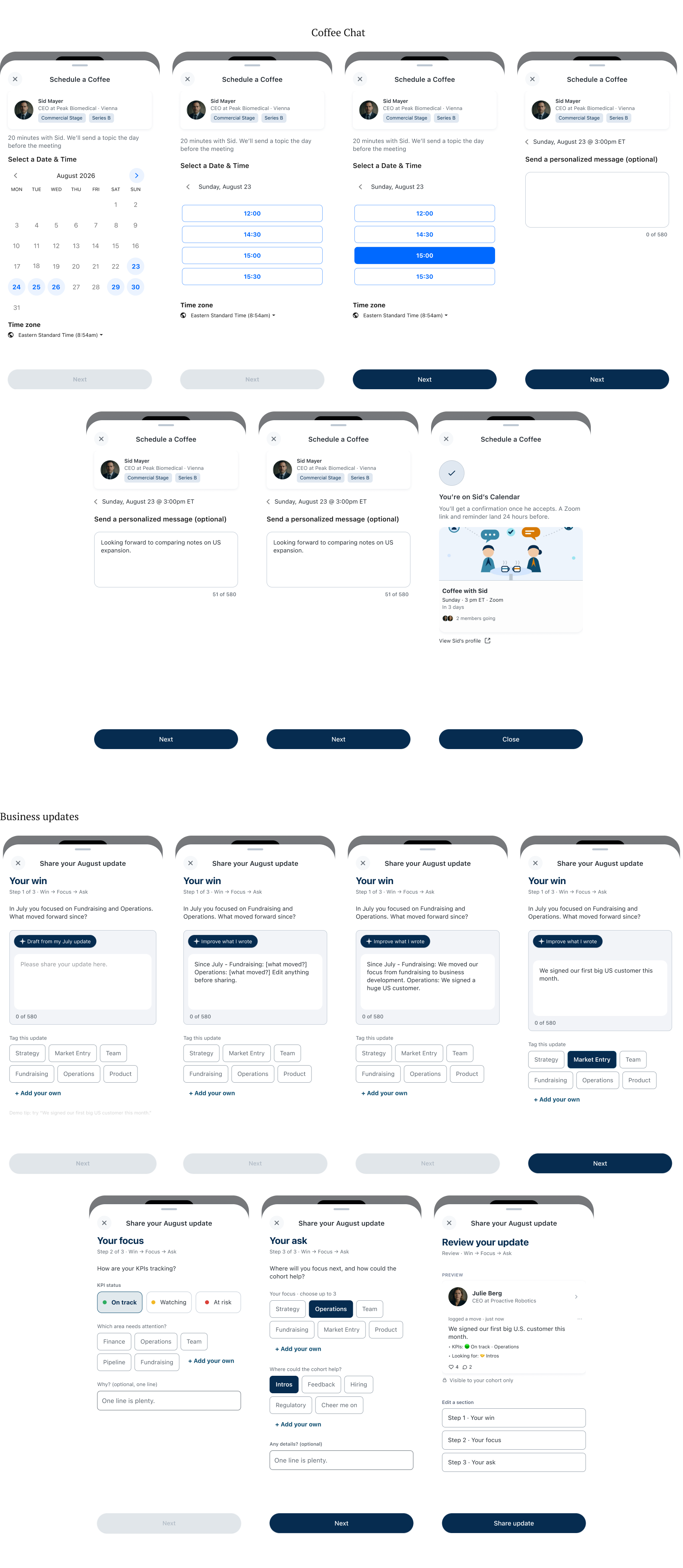
We designed a scheduling flow that makes it easy to book time with a member of your cohort without leaving the platform.
Business Updates
We designed an AI-assisted update flow that lets CEOs share their wins, focus areas, and the support they need without it feeling like homework. The assist is powered live by the Anthropic API. This came directly out of research: members told us they wanted to write their own first draft and get help refining it, not have a draft written for them — "Write with me, not for me."
In-Person and Virtual Event Calendar
The app now includes information about the member's coffee events, cohort sessions and any upcoming CEO XB events, including who else is going and a virtual meeting quick connect.
Native iOS patterns
Initially, we scoped the work to only feature work, limiting the work we did at the platform level. However, as we moved into detailed design, we decided to update the design language to iOS 26 Liquid Glass to create a modern, unified look that matched the native aesthetic.


The Team
MHCI Capstone Team
This work was part of my UCI Masters in Human Computer Interaction capstone. I went back to school after 8+ years as a people leader so that I could get closer to the work I’m meant to do.
The work is evolving fast, and so is how we approach it. I wanted to be part of shaping that, not adapting to it after the fact.
This capstone project let me experiment and try new ways of leading and designing with AI-assisted workflows. It helped me understand how different AI tools might improve our craft and also how they might harm it.
My role on this team was full player and coach. Our distributed team's experience range was from mid-career to early-career and we crossed Pacific, Central, Eastern, and Japan Standard Time. I was learning from the team as much as I was coaching the team on design consistency, particularly around design systems, as well as, designing for native iOS.
Specifically, I led the design system updates so the feature development was consistent across the coffee chat, business updates and events. I also led all stages of research, creating the research plans and contributing to the design of the prototypes.
There was also a bit of project management involved as always. I coached the team on agile methodologies and led our planning sessions through the 20-week capstone.
The Capstone Team
Jarel Mitchell: Prototyping Lead | LinkedIn
Somya Bhatia: Product Designer | LinkedIn
Emily Yang: UX Designer | LinkedIn
Let's Work Together
